






 Trap
 Normal
Disturbance Strategy
View:
875
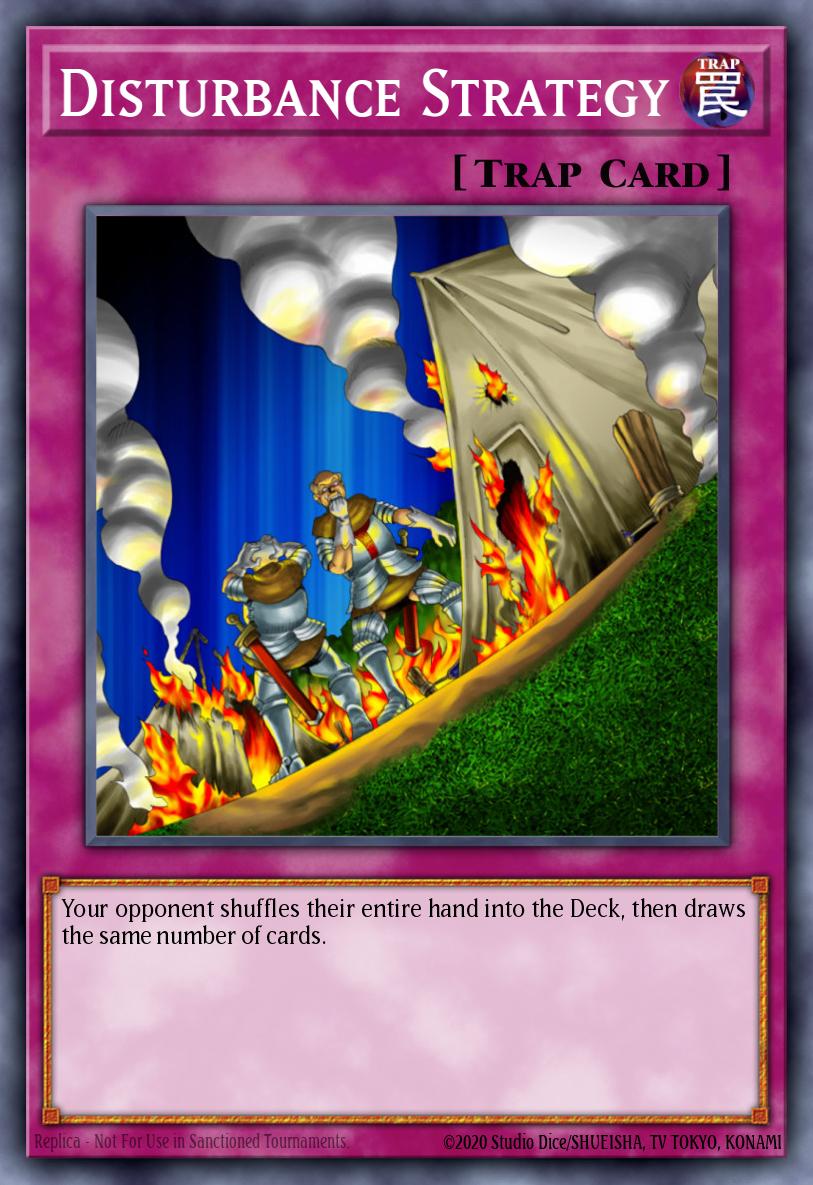
Your opponent shuffles their entire hand into the Deck, then draws the same number of cards.

Disturbance Strategy — Power Evaluation
Final Score: 55 ± 8 · Confidence: Medium
- Intrinsic: 52 · Deck: 56 · Meta: provisional
- Primary role: Negation/Interaction · Secondary: Utility
Why it scores here
Disturbance Strategy is a set Trap whose text only resets the opponent's hand: they shuffle it into the Deck and draw the same number. It converts no board and gains no card advantage for the user, so its score comes almost entirely from disruption value against hand-based starts. Its 264-deck presence across 50 archetypes and frequent pairing with Trap Tracks, Called by the Grave and Droll & Lock Bird confirm it is a practical interaction slot, not a high-power card. The single recorded board shows no starter, searched or payoff role, so combo conversion is scored low.
Axis scores
| Axis | Score | Evidence |
|---|---|---|
| Accessibility | 55 | Live as a set Trap in 264 recent decks at 1.44 average copies, but there is no searcher or starter route in the evidence (observed, inferred). |
| Combo & Conversion | 10 | Builds nothing on its own; the one recorded board shows no starter, searched or payoff role (verified, observed). |
| Resource Economy | 35 | Costs the user a card and gives the opponent a shuffle-and-redraw that is card-neutral for them, so no net advantage (verified, inferred). |
| Effect & Interaction | 55 | Hand reset is soft, non-negating interaction that disrupts hand-based starts but is slow and easy to play around (verified text, inferred strength). |
| Material Utility | 5 | A Trap has no body, so it cannot be used as material and scores near zero (verified). |
| Resilience & Flexibility | 35 | A set Trap is vulnerable to negation and removal, and its effect only matters when the opponent holds cards to shuffle (inferred). |
| Deck-Building Efficiency | 60 | Single-copy-friendly, no garnet or lock restriction, and a low copy count in decks (observed, inferred). |
Calculation
Weight profile: Primary role Negation/Interaction; no secondary blend applied. Intrinsic ≈ 52, Deck ≈ 56, Meta = provisional. Modifiers: none. Final formula: 0.40*Intrinsic + 0.60*Deck
Strengths
- Hand reset disrupts hand-based combo starts and fits Labrynth/Supreme King style hand plays
- Live in 264 recent decks across 50 archetypes at low copy counts
- Cheap to run with no garnet or lock restriction
Weaknesses
- Adds no board or card advantage for the user
- Does not negate, so it cannot stop an effect that is already resolving
- Only one recorded board in the combo evidence, so combo conversion is unverified
Counters / choke points
- Set-trap negation and interruption
- Decks that hold few cards in hand when it is activated
Best use
Hand-disruption trap against hand-based combo starts. Decks: Trap Tracks, Called by the Grave, Droll & Lock Bird, Maxx "C". Suggested copies: 1.
Evidence & gaps
- Verified: Text: opponent shuffles entire hand into Deck, then draws the same number; Card type is Trap; frame is trap; 264 decks, 1.44 average copies, 50 distinct archetypes; Combo appearance 1 with no starter, searched, material or payoff role
- Observed: Top partners Trap Tracks (42.8%), Called by the Grave (42.0%), Droll & Lock Bird (40.9%); Archetype spread across Supreme King, Labrynth, Destiny Heros, Trickstar
- Inferred: Soft interaction: disrupts hand plans but does not negate; Vulnerable to set-trap negation and removal; Card-neutral for opponent, so net advantage is zero
- Data gaps: no guides supplied no usage statistics (StatisticsCard) — archetype inclusion % inferred from deck sample only only one recorded combo board; combo conversion evidence is very thin